A Bitcoin cryptocurrency souvenir coin. Bitcoin’s price is up 600% over the past 12 months Photograph: A
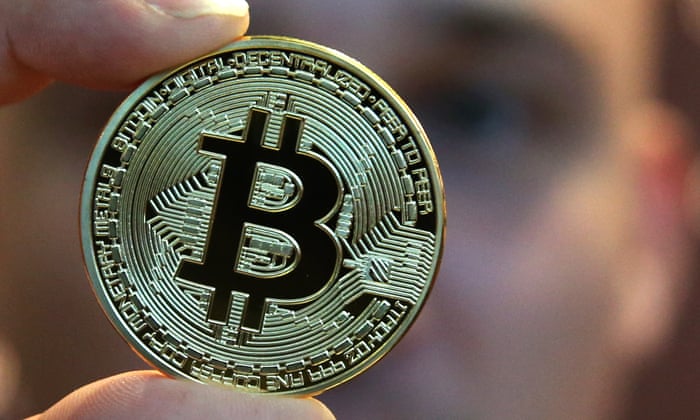
A Bitcoin cryptocurrency souvenir coin.
Bitcoin’s price is up 600% over the past 12 months
Photograph:
Is the cryptocurrency bitcoin the biggest bubble in the
world today, or a great investment bet on the cutting edge of new-age financial
technology? My best guess is that in the long run, the technology will thrive,
but that the price of bitcoin will collapse.
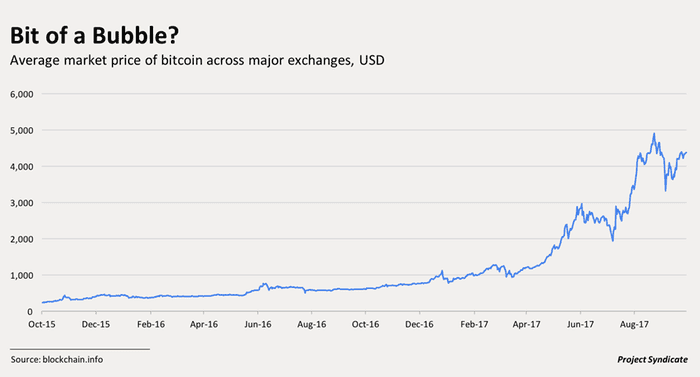
If you haven’t been following the bitcoin story, its price
is up 600% over the past 12 months, and 1,600% in the past 24 months. At over
$4,200 (as of 5 October), a single unit of the virtual currency is now worth
more than three times an ounce of gold. Some bitcoin evangelists see it going
far higher in the next few years.
What happens from here will depend a lot on how governments
react. Will they tolerate anonymous payment systems that facilitate tax evasion
and crime? Will they create digital currencies of their own? Another key
question is how successfully bitcoin’s numerous “alt-coin” competitors can
penetrate the market.
In principle, it is supremely easy to clone or improve on
bitcoin’s technology. What is not so easy is to duplicate bitcoin’s established
lead in credibility and the large ecosystem of applications that have built up
around it.
For now, the regulatory environment remains a free-for-all.
China’s government, concerned about the use of bitcoin in capital flight and
tax evasion, has recently banned bitcoin exchanges. Japan, on the other hand,
has enshrined bitcoin as legal tender, in an apparent bid to become the global
centre of fintech.
The United States is taking tentative steps to follow Japan
in regulating fintech, though the endgame is far from clear. Importantly,
bitcoin does not need to win every battle to justify a sky-high price. Japan,
the world’s third largest economy, has an extraordinarily high
currency-to-income ratio (roughly 20%), so bitcoin’s success there is a major
triumph.
Advertisement
In Silicon Valley, drooling executives are both investing in
bitcoin and pouring money into competitors. After bitcoin, the most important
is Ethereum. The sweeping, Amazon-like ambition of Ethereum is to allow its
users to employ the same general technology to negotiate and write “smart
contracts” for just about anything.
As of early October, Ethereum’s market capitalisation stood
at $28bn, versus $72bn for bitcoin. Ripple, a platform championed by the
banking sector to slash transaction costs for interbank and overseas transfers,
is a distant third at $9bn. Behind the top three are dozens of fledgling
competitors.
Most experts agree that the ingenious technology behind
virtual currencies may have broad applications for cybersecurity, which
currently poses one of the biggest challenges to the stability of the global
financial system. For many developers, the goal of achieving a cheaper, more
secure payments mechanism has supplanted bitcoin’s ambition of replacing
dollars.
But it is folly to think that bitcoin will ever be allowed
to supplant central-bank-issued money. It is one thing for governments to allow
small anonymous transactions with virtual currencies; indeed, this would be
desirable. But it is an entirely different matter for governments to allow
large-scale anonymous payments, which would make it extremely difficult to
collect taxes or counter criminal activity. Of course, as I note in my recent
book on past, present, and future currencies, governments that issue
large-denomination bills also risk aiding tax evasion and crime. But cash at
least has bulk, unlike virtual currency.
Introducing the new celebrity accessory: bitcoin-style
cryptocurrencies
Read more
It will be interesting to see how the Japanese experiment
evolves. The government has indicated that it will force bitcoin exchanges to
be on the lookout for criminal activity and to collect information on deposit
holders. Still, one can be sure that global tax evaders will seek ways to
acquire bitcoin anonymously abroad and then launder their money through
Japanese accounts. Carrying paper currency in and out of a country is a major
cost for tax evaders and criminals; by embracing virtual currencies, Japan
risks becoming a Switzerland-like tax haven – with the bank secrecy laws baked
into the technology.
Advertisement
Were bitcoin stripped of its near-anonymity, it would be
hard to justify its current price. Perhaps bitcoin speculators are betting that
there will always be a consortium of rogue states allowing anonymous bitcoin
usage, or even state actors such as North Korea that will exploit it.
Would the price of bitcoin drop to zero if governments could
perfectly observe transactions? Perhaps not. Even though bitcoin transactions
require an exorbitant amount of electricity, with some improvements, bitcoin
might still beat the 2% fees the big banks charge on credit and debit cards.
Finally, it is hard to see what would stop central banks
from creating their own digital currencies and using regulation to tilt the
playing field until they win. The long history of currency tells us that what
the private sector innovates, the state eventually regulates and appropriates.
I have no idea where bitcoin’s price will go over the next couple years, but
there is no reason to expect virtual currency to avoid a similar fate.


Comments
Post a Comment